Portfolio Strategy
Your UX Portfolio Is Your Most Important Product
Learn how to treat your UX portfolio like a product: define your audience, improve the user journey, and make your case studies easier to evaluate.

By Ömer Arı
3 min read
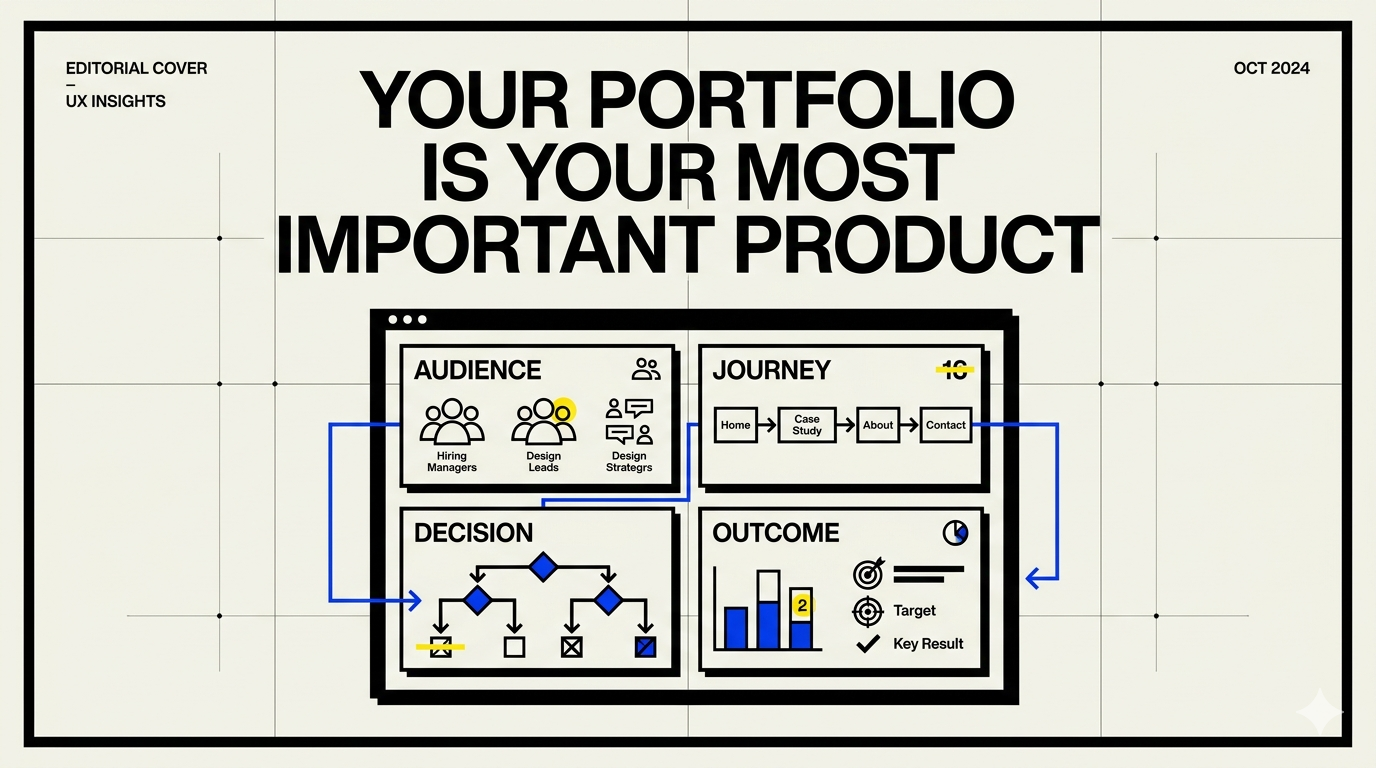
Your portfolio is not just a place to store your work.
It is the product that represents how you think, decide, communicate, and grow as a designer.
If you are applying for design roles, your portfolio has a job to do. It needs to help someone understand whether you are worth interviewing.
That makes your portfolio more than a gallery. It is a product experience.
Your portfolio has users
A portfolio is usually read by different people with different goals.
A recruiter may scan for role fit.
A design lead may look for decision-making.
A product manager may look for collaboration and business awareness.
A founder may look for ownership and practical problem-solving.
They are not all reading with the same depth or patience.
That means your portfolio needs to work for quick scanning and deeper evaluation.
Your portfolio has a job to do
A strong UX portfolio should help the reader answer:
- What kind of designer are you?
- What problems have you worked on?
- What was your role?
- How did you make decisions?
- How did you handle constraints?
- What changed because of your work?
- Why should we talk to you?
If the reader has to guess these answers, the portfolio is not doing enough work.
Treat your portfolio like a product
Ask the same questions you would ask for a product:
- Who is the primary audience?
- What action do I want them to take?
- Where might they get confused?
- What information do they need first?
- What should be removed?
- What is the clearest path through the experience?
This shift changes the way you write case studies.
You stop asking, “What should I upload?”
You start asking, “What does the reader need to understand?”
The portfolio user journey
A hiring team usually moves through your portfolio in a rough sequence:
- First impression
- Project selection
- Case study scan
- Role and contribution check
- Decision quality
- Interview decision
Each step can either build trust or create friction.
If your project titles are vague, the reader may not click.
If your case study is too long, they may skim and miss the point.
If your role is unclear, they may question ownership.
If your decisions are unexplained, they may not see your thinking.
Case studies reduce uncertainty
A good case study does not just display work. It reduces uncertainty.
It should make the reader feel:
- I understand the problem.
- I understand what this designer owned.
- I understand why key decisions were made.
- I understand the trade-offs.
- I understand what this designer learned.
That is what creates confidence before an interview.
Quick portfolio audit
Use these questions:
- Can someone understand my role in 30 seconds?
- Do my case studies explain decisions, not just steps?
- Are my strongest projects easiest to find?
- Is the outcome honest and specific?
- Would this portfolio help me talk in an interview?
Final thought
If your portfolio is your most important product, every case study is a feature inside that product.
Make each one useful, clear, and easy to evaluate.
Related guides
- You may also want to show your contribution clearly: read the guide
- You may also want to prepare the same story for interviews: read the guide
Related reading
Mar 19, 2026
2 min read
How Many UX Case Studies Should You Have in Your Portfolio?
Learn why a few strong UX case studies are usually more effective than a large collection of shallow projects.
Apr 29, 2026
2 min read
How to Turn Portfolio Rejection Into Better Case Studies
Learn how to use portfolio rejection, recruiter silence, and interview feedback as signals to improve your UX case studies.
Apr 28, 2026
2 min read
What to Include in a Product Design Portfolio
A focused checklist for the evidence, case studies, and narrative details that make product design portfolios stronger.