Designer Confidence
How to Turn Portfolio Rejection Into Better Case Studies
Learn how to use portfolio rejection, recruiter silence, and interview feedback as signals to improve your UX case studies.

By Ömer Arı
2 min read
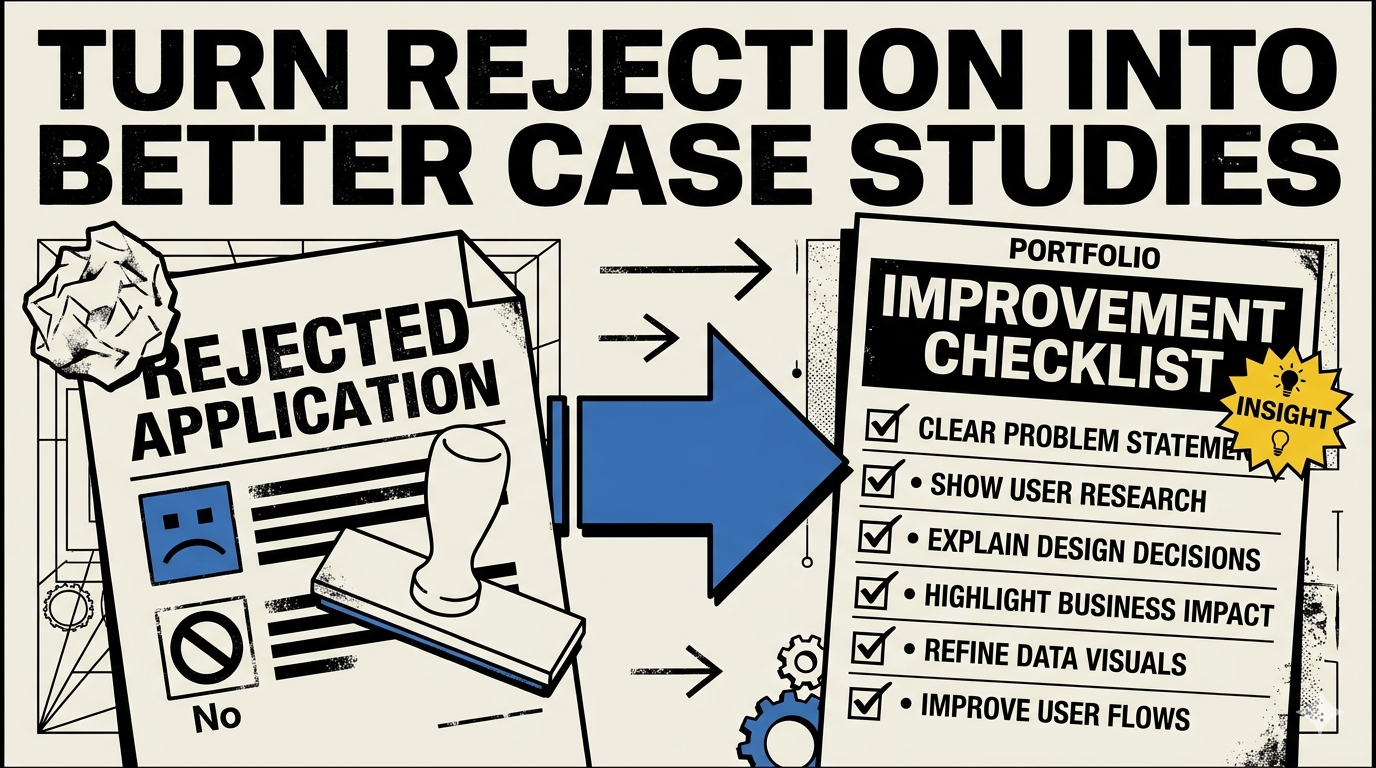
A rejection can feel personal.
But sometimes it is also data.
If you know what to look for, every no-response, rejection email, or weak interview can help you improve your portfolio.
Do not treat every rejection the same
Different signals mean different things.
No replies may mean your portfolio is not creating enough initial confidence.
Interview drop-off may mean your case study is interesting, but your explanation is not strong enough.
Portfolio confusion may mean your role, process, or outcome is unclear.
Look for patterns
One rejection may not mean much.
Five similar signals might.
Track:
- Which roles you applied to
- Which portfolio version you used
- Which case studies were shown
- Whether you got a reply
- Whether you reached an interview
- What questions came up
- What feedback you received
This turns emotion into information.
Diagnose the case study
Ask:
- Is the problem clear?
- Is my role specific?
- Are decisions explained?
- Is the outcome honest?
- Is the case study too long?
- Is it too visual and not enough strategic?
- Would I be able to present it in 10 minutes?
Improve one thing at a time
Do not rewrite your entire portfolio after every rejection.
Choose one improvement:
- Rewrite the project title
- Clarify your role
- Add one decision explanation
- Remove unnecessary process details
- Improve the outcome section
- Add a reflection paragraph
Small iterations are easier to maintain.
Use feedback carefully
Not all feedback is equally useful.
Some feedback is specific and actionable.
Some is vague.
Some reflects the company’s needs, not your value.
Use feedback as input, not identity.
Final thought
A rejection is not proof that your work has no value.
It may be a signal that the story needs more clarity.
Related guides
- You may also want to prepare a sharper portfolio presentation: read the guide
- You may also want to improve case studies that do not have metrics: read the guide
Related reading
Mar 19, 2026
2 min read
How Many UX Case Studies Should You Have in Your Portfolio?
Learn why a few strong UX case studies are usually more effective than a large collection of shallow projects.
Apr 2, 2026
2 min read
How to Prepare a UX Portfolio Presentation for a Design Interview
Learn how to turn your UX case study into a focused portfolio presentation for design interviews, with timing, structure, and storytelling tips.
Jan 8, 2026
3 min read
Your UX Portfolio Is Your Most Important Product
Learn how to treat your UX portfolio like a product: define your audience, improve the user journey, and make your case studies easier to evaluate.