Portfolio Strategy
How Many UX Case Studies Should You Have in Your Portfolio?
Learn why a few strong UX case studies are usually more effective than a large collection of shallow projects.

By Ömer Arı
2 min read
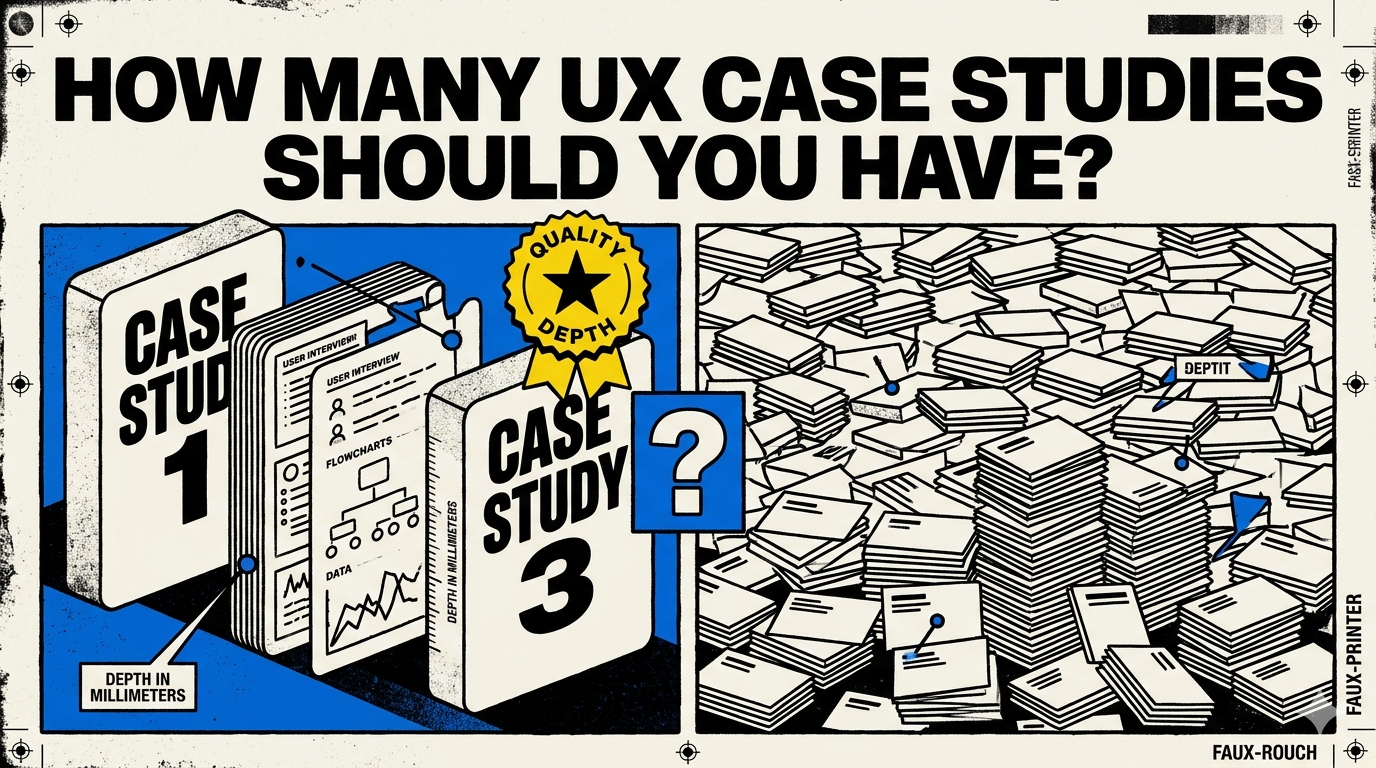
More projects do not always create more trust.
Sometimes, they create more noise.
A portfolio with three strong case studies is usually more effective than a portfolio with ten shallow projects.
The real question
The question is not:
“How many projects can I show?”
The better question is:
“How many projects help someone understand my skills?”
Every case study should have a reason to exist.
A useful starting point
For most UX/Product Designers, 2–4 strong case studies are enough.
This usually gives you space to show:
- Different problem types
- Different responsibilities
- Different product areas
- Different strengths
- Growth over time
But each case study needs depth.
When one case study may be enough
One case study can be enough if it is highly relevant, deep, and clearly written.
For example, if you are applying for a fintech product role and you have one strong fintech case study, that may be more useful than five unrelated student projects.
When more case studies help
More case studies can help if they show range.
For example:
- One research-heavy project
- One product strategy project
- One complex UI project
- One shipped product improvement
- One team collaboration case
But range without clarity does not help.
How to choose projects
Use this filter:
- Is the problem clear?
- Was my role meaningful?
- Can I explain important decisions?
- Is there an outcome or learning?
- Is this relevant to the roles I want?
- Can I talk about it confidently in an interview?
If the answer is no, the project may not belong in your main portfolio.
What to avoid
Avoid adding projects just to look experienced.
Avoid projects where your role is unclear.
Avoid visual-only projects unless you can explain the problem and reasoning.
Avoid case studies that feel unfinished without context.
Final thought
Your portfolio is not a storage room.
It is a curated argument for why someone should talk to you.
Related guides
- You may also want to case studies without metrics: read the guide
- You may also want to portfolio presentations for design interviews: read the guide
Related reading
Apr 29, 2026
2 min read
How to Turn Portfolio Rejection Into Better Case Studies
Learn how to use portfolio rejection, recruiter silence, and interview feedback as signals to improve your UX case studies.
Jan 8, 2026
3 min read
Your UX Portfolio Is Your Most Important Product
Learn how to treat your UX portfolio like a product: define your audience, improve the user journey, and make your case studies easier to evaluate.
Apr 28, 2026
2 min read
What to Include in a Product Design Portfolio
A focused checklist for the evidence, case studies, and narrative details that make product design portfolios stronger.