Design Interviews
How to Prepare a UX Portfolio Presentation for a Design Interview
Learn how to turn your UX case study into a focused portfolio presentation for design interviews, with timing, structure, and storytelling tips.

By Ömer Arı
2 min read
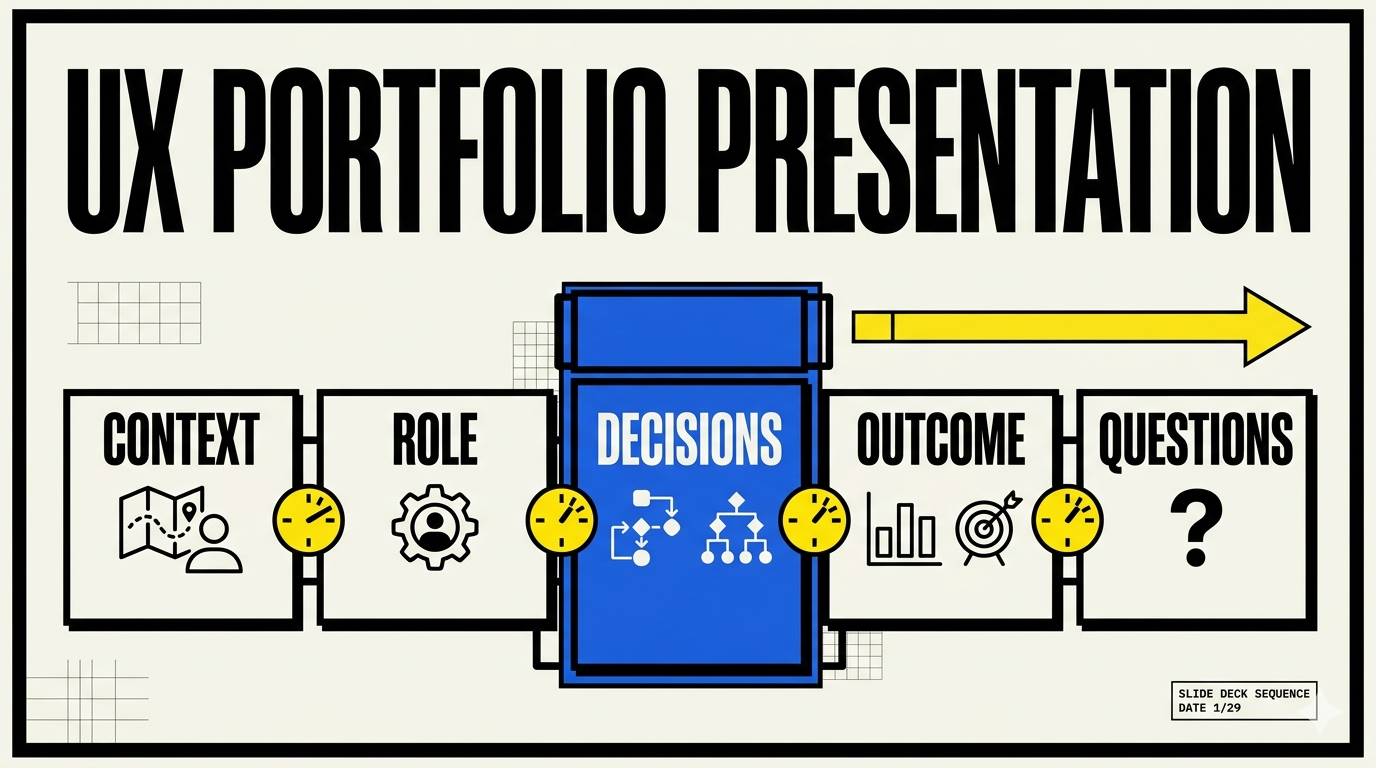
Do not just open your portfolio and scroll.
A design interview is not a website walkthrough.
It is a focused conversation about your thinking.
Why scrolling is risky
When you scroll through a portfolio, you give up control of the story.
You may spend too much time on context.
You may skip the important decision.
You may get distracted by visual details.
You may run out of time before the outcome.
A presentation helps you guide the reader.
Choose one strong case study
For most interviews, one focused case study is better than three rushed ones.
Choose a project where you can explain:
- The problem
- Your role
- Key constraints
- Important decisions
- Outcome or learning
- What you would improve
Use a simple timing structure
For a 15-minute presentation:
- 1 minute: setup
- 3 minutes: context and problem
- 3 minutes: your role and constraints
- 5 minutes: key decisions
- 2 minutes: outcome and learnings
- 1 minute: transition to questions
This keeps the story focused.
Do not present every screen
Your goal is not to prove that you made many artifacts.
Your goal is to show how you think.
Show only the artifacts that help the story:
- A journey map that revealed the problem
- A wireframe that shows a decision
- A before/after that explains improvement
- A usability finding that changed the design
Prepare for interruptions
Interviewers may stop you and ask:
- Why did you choose this direction?
- What alternatives did you consider?
- What was your role?
- How did you work with engineers?
- What would you do differently?
A strong case study prepares you for these questions.
End with reflection
Do not end only with final screens.
End with what you learned.
This shows maturity.
Final thought
A portfolio presentation is not about showing everything.
It is about helping the interview panel understand your thinking quickly.
Related guides
- You may also want to justify design decisions clearly: read the guide
- You may also want to show your contribution without overclaiming: read the guide
Related reading
Apr 29, 2026
2 min read
How to Turn Portfolio Rejection Into Better Case Studies
Learn how to use portfolio rejection, recruiter silence, and interview feedback as signals to improve your UX case studies.
Mar 19, 2026
2 min read
How Many UX Case Studies Should You Have in Your Portfolio?
Learn why a few strong UX case studies are usually more effective than a large collection of shallow projects.
Jan 8, 2026
3 min read
Your UX Portfolio Is Your Most Important Product
Learn how to treat your UX portfolio like a product: define your audience, improve the user journey, and make your case studies easier to evaluate.