Case Study Writing
How to Write UX Case Study Titles That Get Attention
Learn how to write clear and specific UX case study titles that communicate problem, context, and impact without sounding generic.

By Ömer Arı
2 min read
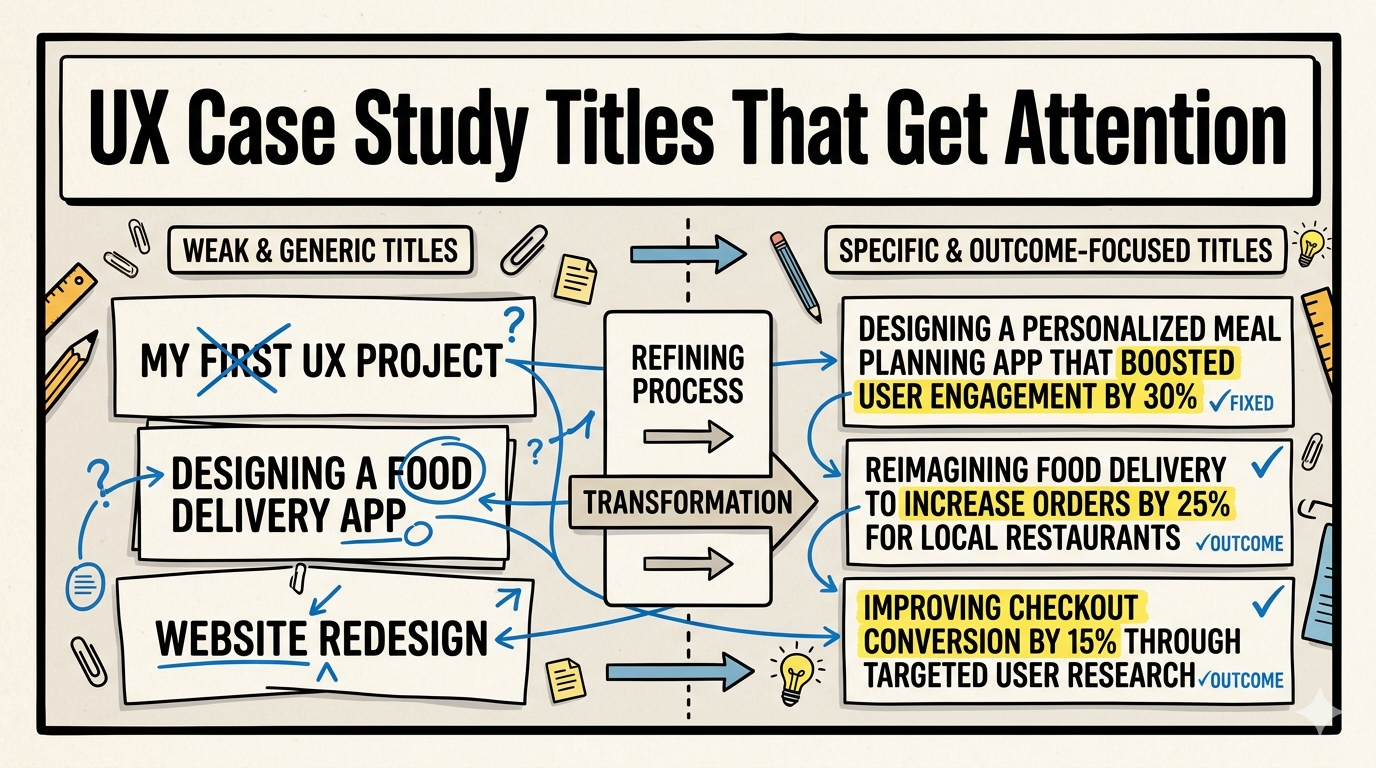
A case study title is not just a label.
It is the first promise you make to the reader.
A vague title can make strong work look forgettable.
The problem with generic titles
Titles like these are common:
- Food Delivery App UX
- Banking App Redesign
- E-commerce Checkout
- Travel App Case Study
They describe the category, but not the story.
The reader still does not know:
- What problem did you solve?
- Who was it for?
- Why did it matter?
- What changed?
A stronger title gives context
A better title usually includes one of these:
- The problem
- The user group
- The outcome
- The constraint
- The business context
For example:
Generic: Food Delivery App UX
Better: Reducing Checkout Confusion in a Food Delivery App
Generic: Banking App Redesign
Better: Simplifying First-Time Money Transfers for Mobile Banking Users
Title formula 1: Problem-led
Use this when the problem is strong.
Formula:
Solving [problem] for [user/context]
Example:
Solving Onboarding Drop-off for First-Time Budgeting App Users
Title formula 2: Outcome-led
Use this when you have a clear result.
Formula:
Improving [metric or outcome] through [design change]
Example:
Improving Account Setup Completion Through a Simpler Onboarding Flow
Title formula 3: Role-led
Use this when your contribution matters.
Formula:
My Role in [project/problem]: [specific contribution]
Example:
My Role in Redesigning a Checkout Flow Under Technical Constraints
Title formula 4: Constraint-led
Use this when the project had real complexity.
Formula:
Designing [solution] under [constraint]
Example:
Designing a Faster Claims Flow Under Compliance Constraints
Avoid overclaiming
Do not force a dramatic title if the project does not support it.
A clear title is better than a loud title.
Final thought
A strong title helps the right reader understand why the case study matters before they open it.
Related guides
- You may also want to prepare your case study for interview conversations: read the guide
- You may also want to write for global job applications: read the guide
Related reading
Apr 16, 2026
3 min read
Common UX Case Study Mistakes That Make Strong Work Look Weak
Avoid common UX case study mistakes that hide strong design work, from unclear roles to overclaiming impact.
Mar 26, 2026
3 min read
How to Start a UX Case Study When You Feel Stuck
A practical way to begin your UX case study when the blank page feels too big and you do not know what to write first.
Jan 1, 2026
2 min read
Hello Designcase
What this blog is for, why Folioverse is publishing it, and what designers can expect from the first set of guides.