writing
How to Start a UX Case Study When You Feel Stuck
A practical way to begin your UX case study when the blank page feels too big and you do not know what to write first.

By Ömer Arı
3 min read
The real problem
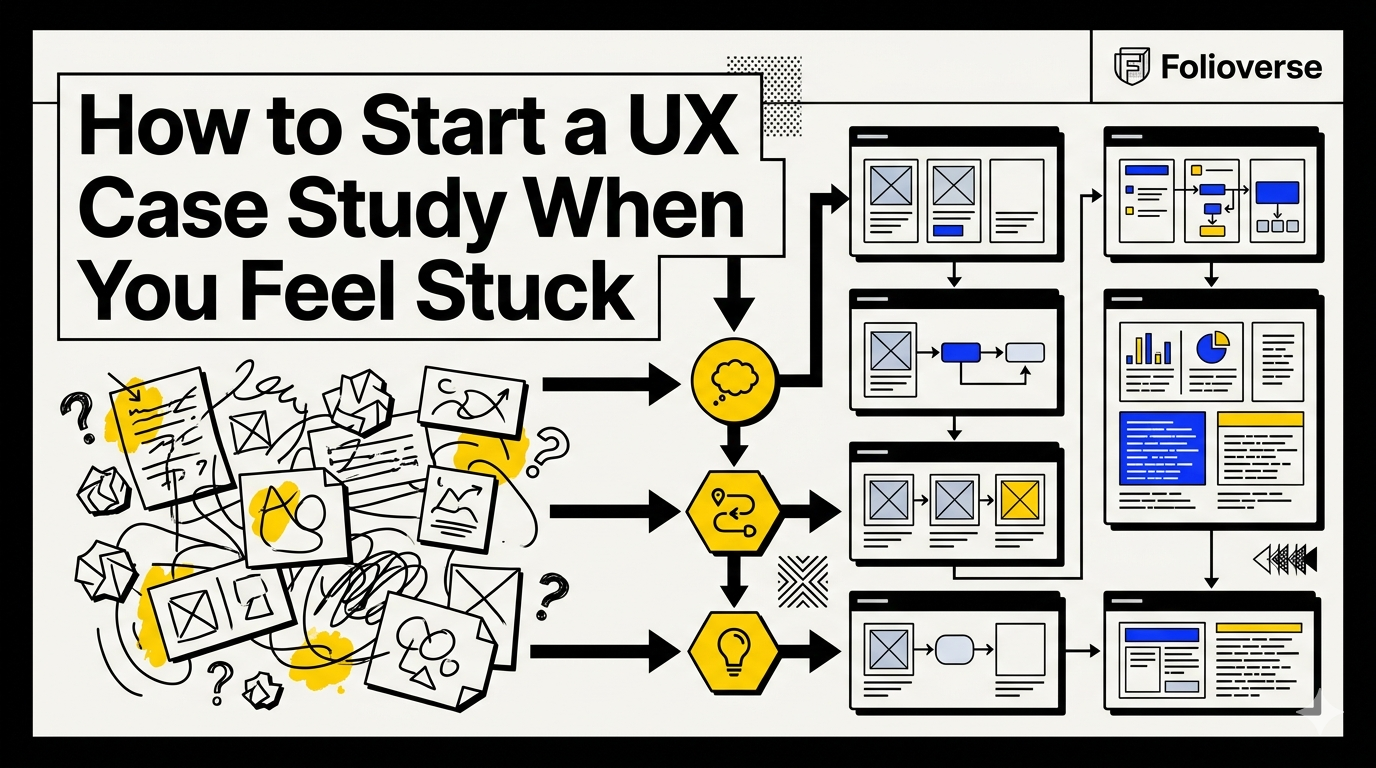
Most designers do not get stuck because they have nothing to say. They get stuck because they try to write the final story too early. A better way to start is to collect the raw material first: the problem, your role, key decisions, constraints, and one important change that happened during the project.
This is where many portfolio pages lose strength. They show activity, but not reasoning. They show artifacts, but not the thinking behind them. For a hiring team, mentor, or reviewer, that missing reasoning can make even good work feel hard to evaluate.
What to focus on instead
A stronger case study does not need to sound dramatic. It needs to make the work easier to understand. The reader should be able to see what problem you worked on, what your role was, what choices you made, why those choices made sense, and what changed because of the work.
Key principles:
- Do not start with the perfect introduction.
- Start with one project moment you remember clearly.
- Write messy notes before polished paragraphs.
- Answer one focused question at a time.
- Turn notes into structure only after the thinking is visible.
A practical structure
Use this simple flow:
- Context: What was the product, team, or situation?
- Problem: What needed to change or become clearer?
- Role: What were you responsible for?
- Decision: What important choices did you make?
- Reasoning: What evidence, constraint, or trade-off shaped those choices?
- Outcome: What changed, what was learned, or what became easier?
This structure keeps the case study readable without turning it into a shallow template. The goal is not to fill sections. The goal is to help someone understand your thinking.
Example framing
Weak framing:
I redesigned the flow and improved the user experience.
Stronger framing:
I focused on the onboarding step where users were unsure what to do next. Instead of adding more explanation, I simplified the sequence and made the next action more visible. This helped the team align around a clearer first-use experience.
The stronger version does not depend on exaggerated claims. It explains the situation, the decision, and the reasoning.
What to avoid
- Do not turn the case study into a gallery of screens.
- Do not hide your role behind vague “we” language.
- Do not overclaim impact if you do not have evidence.
- Do not describe every step equally; highlight the decisions that mattered.
- Do not copy another designer’s case study structure without adapting it to your own project.
Final thought
A strong UX case study is not just proof that you worked on a product. It is proof that you can think through a problem and explain your choices clearly.
More case study guides
Related reading
Apr 16, 2026
3 min read
Common UX Case Study Mistakes That Make Strong Work Look Weak
Avoid common UX case study mistakes that hide strong design work, from unclear roles to overclaiming impact.
Jan 15, 2026
3 min read
How to Explain Your Design Decisions in a UX Case Study
Learn how to turn design decisions into a clearer UX case study narrative that shows how you think, not just what you designed.
Apr 30, 2026
4 min read
Why Your UX Case Study Feels Weak Even If the Project Was Good
If your project was strong but the case study feels weak, the problem may be missing narrative clarity rather than missing work.