Portfolio Strategy
Junior vs Senior UX Portfolios: What Actually Changes?
Understand how expectations change between junior, mid-level, and senior UX portfolios, from process explanation to business impact and leadership signals.

By Ömer Arı
2 min read
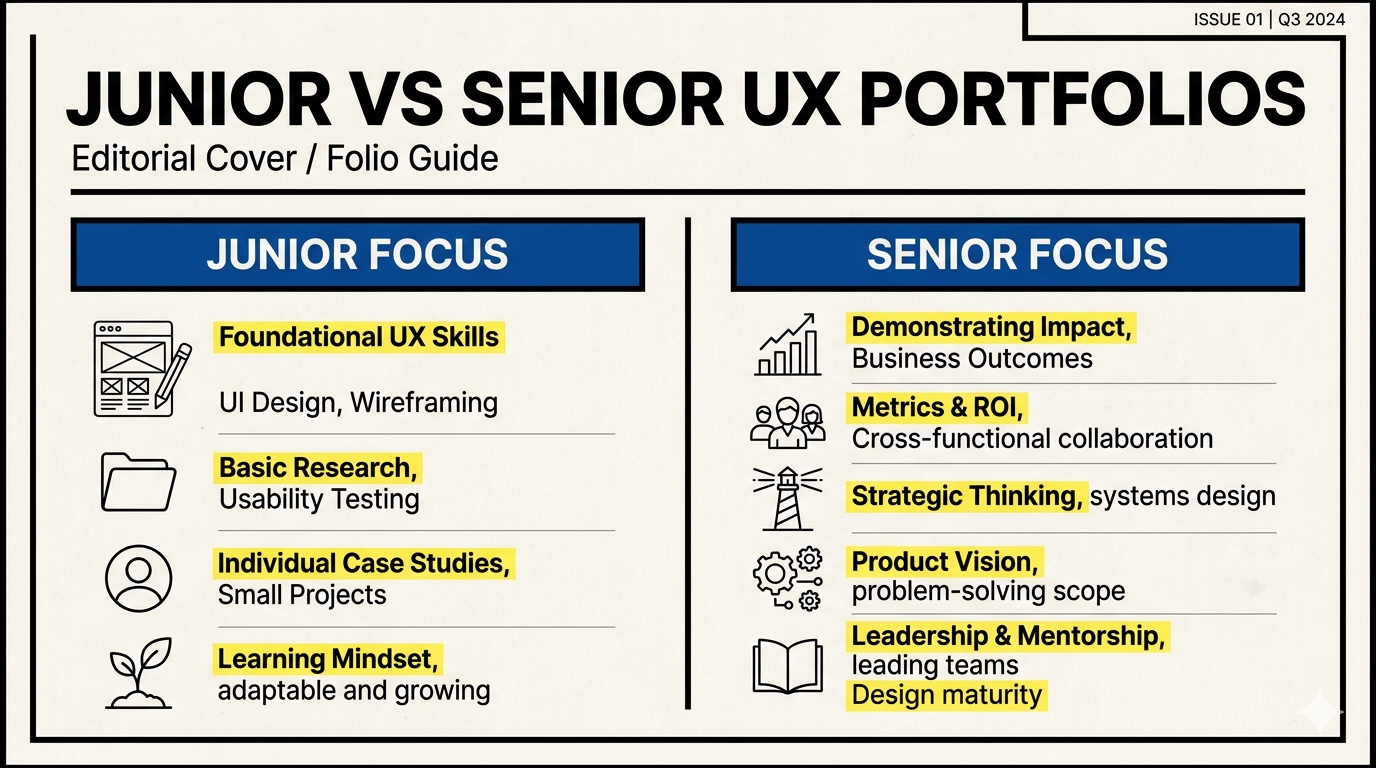
A junior portfolio and a senior portfolio should not tell the same story.
Both can be strong. But they are evaluated differently.
As designers grow, portfolios need to show more than process. They need to show judgment, ownership, collaboration, and impact.
What junior portfolios need to prove
A junior portfolio usually needs to show:
- Basic UX process understanding
- Clear problem framing
- Willingness to learn
- Ability to explain decisions
- Good craft foundations
- Coachability
The reader may not expect huge business impact.
But they do expect clarity.
A junior case study should answer:
- What was the problem?
- What was your role?
- What steps did you take?
- What did you learn?
- Why did you make key decisions?
What mid-level portfolios need to prove
A mid-level designer needs to show more ownership.
The portfolio should show:
- Stronger decision-making
- Collaboration with product and engineering
- Trade-offs
- Constraints
- Measurable or observable outcomes
- Clear contribution in team projects
At this level, showing only process steps is not enough.
The reader wants to see how you handled real-world complexity.
What senior portfolios need to prove
A senior portfolio should show judgment.
That means:
- Choosing the right problem
- Influencing direction
- Handling ambiguity
- Aligning stakeholders
- Making trade-offs
- Connecting design to business outcomes
- Improving team or product quality
Senior case studies do not need to be longer.
They need to be sharper.
The biggest difference
Junior portfolios often say:
“I followed the process.”
Senior portfolios show:
“I understood the situation, made decisions, and created leverage.”
That is the shift.
How to make your portfolio feel more mature
You do not need to exaggerate your title.
Instead, improve how you explain:
- Why the problem mattered
- What you personally owned
- What constraints shaped the work
- Which decisions were difficult
- What trade-offs were made
- What changed after the project
- What you would do differently now
Final thought
A stronger portfolio is not always a more beautiful portfolio.
It is a clearer signal of how you think at your current level.
Related guides
- You may also want to make your contribution visible: read the guide
- You may also want to write for global applications: read the guide
Related reading
Apr 28, 2026
2 min read
What to Include in a Product Design Portfolio
A focused checklist for the evidence, case studies, and narrative details that make product design portfolios stronger.
Mar 19, 2026
2 min read
How Many UX Case Studies Should You Have in Your Portfolio?
Learn why a few strong UX case studies are usually more effective than a large collection of shallow projects.
Jan 8, 2026
3 min read
Your UX Portfolio Is Your Most Important Product
Learn how to treat your UX portfolio like a product: define your audience, improve the user journey, and make your case studies easier to evaluate.