career
How to Write an English UX Case Study for Global Job Applications
Learn how to write a clear English UX case study for international applications without sounding overly complex or generic.

By Ömer Arı
3 min read
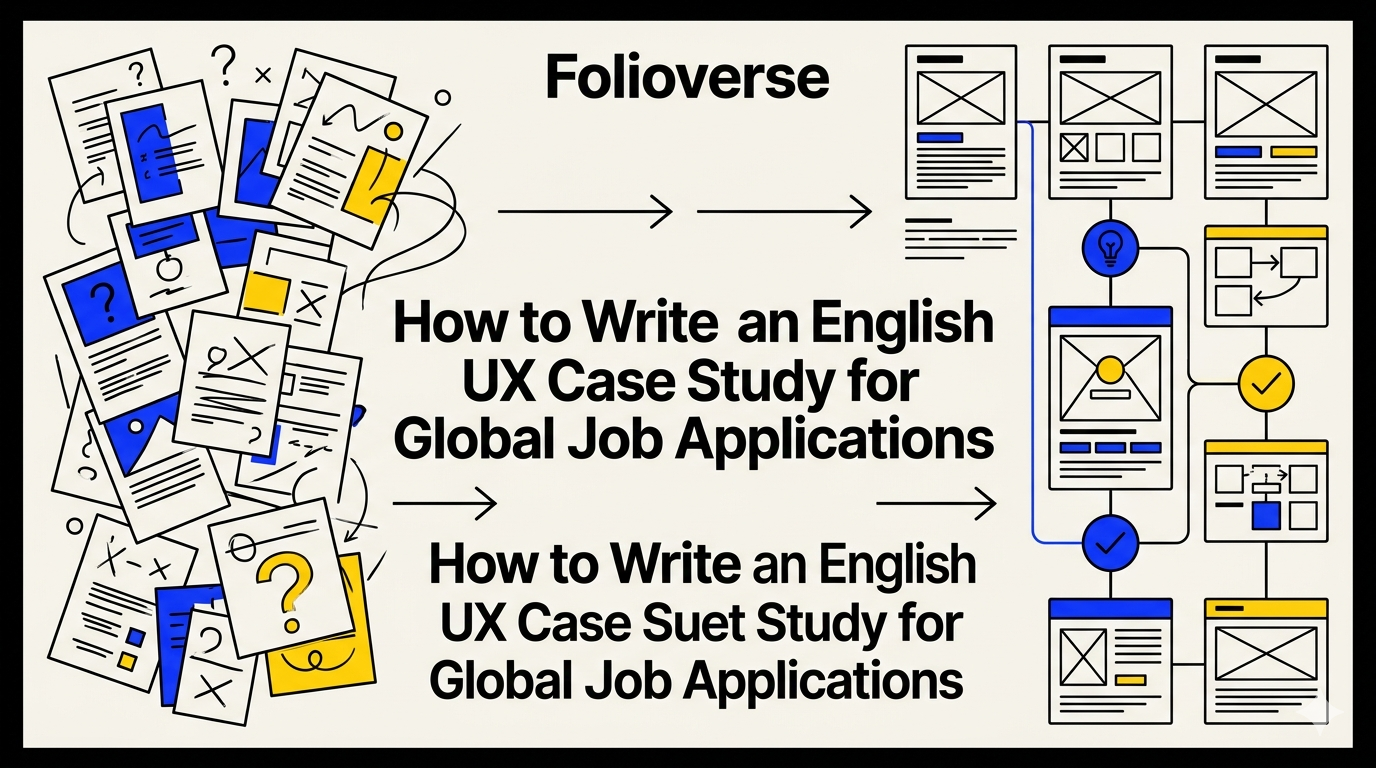
The real problem
For global applications, your English case study does not need to sound fancy. It needs to be clear. Recruiters and design leads may skim quickly, compare many candidates, and read across different cultural contexts. Clarity matters more than complex wording.
This is where many portfolio pages lose strength. They show activity, but not reasoning. They show artifacts, but not the thinking behind them. For a hiring team, mentor, or reviewer, that missing reasoning can make even good work feel hard to evaluate.
What to focus on instead
A stronger case study does not need to sound dramatic. It needs to make the work easier to understand. The reader should be able to see what problem you worked on, what your role was, what choices you made, why those choices made sense, and what changed because of the work.
Key principles:
- Use simple verbs and direct sentences.
- Avoid vague claims like “improved the experience.”
- Explain your role early.
- Use consistent section headings.
- Prefer clarity over impressive-sounding jargon.
A practical structure
Use this simple flow:
- Context: What was the product, team, or situation?
- Problem: What needed to change or become clearer?
- Role: What were you responsible for?
- Decision: What important choices did you make?
- Reasoning: What evidence, constraint, or trade-off shaped those choices?
- Outcome: What changed, what was learned, or what became easier?
This structure keeps the case study readable without turning it into a shallow template. The goal is not to fill sections. The goal is to help someone understand your thinking.
Example framing
Weak framing:
I redesigned the flow and improved the user experience.
Stronger framing:
I focused on the onboarding step where users were unsure what to do next. Instead of adding more explanation, I simplified the sequence and made the next action more visible. This helped the team align around a clearer first-use experience.
The stronger version does not depend on exaggerated claims. It explains the situation, the decision, and the reasoning.
What to avoid
- Do not turn the case study into a gallery of screens.
- Do not hide your role behind vague “we” language.
- Do not overclaim impact if you do not have evidence.
- Do not describe every step equally; highlight the decisions that mattered.
- Do not copy another designer’s case study structure without adapting it to your own project.
Final thought
A strong UX case study is not just proof that you worked on a product. It is proof that you can think through a problem and explain your choices clearly.
More case study guides
Related reading
Apr 29, 2026
2 min read
How to Turn Portfolio Rejection Into Better Case Studies
Learn how to use portfolio rejection, recruiter silence, and interview feedback as signals to improve your UX case studies.
Apr 28, 2026
2 min read
What to Include in a Product Design Portfolio
A focused checklist for the evidence, case studies, and narrative details that make product design portfolios stronger.
Apr 2, 2026
2 min read
How to Prepare a UX Portfolio Presentation for a Design Interview
Learn how to turn your UX case study into a focused portfolio presentation for design interviews, with timing, structure, and storytelling tips.