Research Insights
How to Present Research Insights Without Boring the Reader
Learn how to choose and present research insights in a UX case study without overwhelming the reader with personas, surveys, and raw data.

By Ömer Arı
2 min read
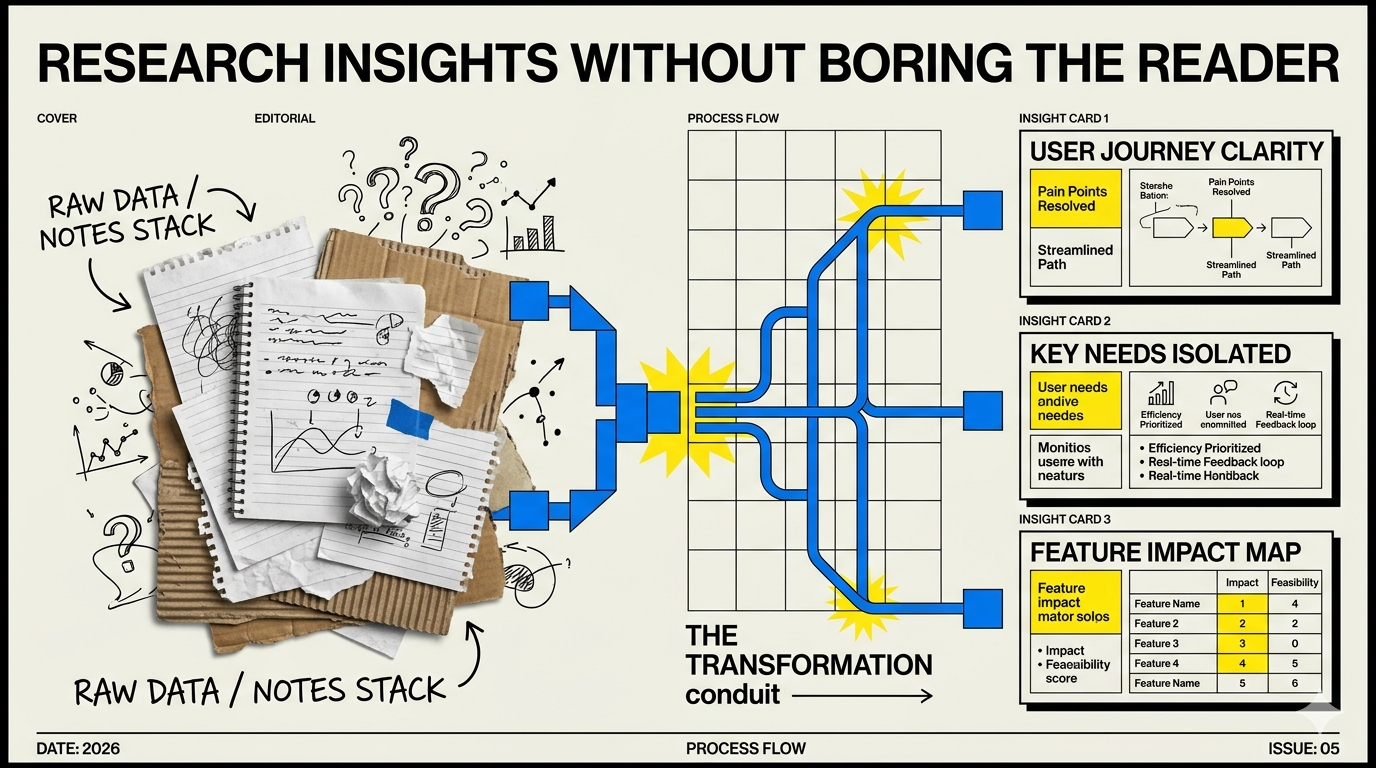
Research is not strong because it is long.
It is strong when it explains what changed because of what you learned.
The common mistake
Many designers add every research artifact:
- Personas
- Surveys
- Interview notes
- Empathy maps
- Journey maps
- Workshop screenshots
But the reader is left wondering:
“So what?”
A case study should not become a research archive.
Research should support decisions
A case study does not need every research detail.
It needs the insights that shaped the product.
For each insight, ask:
- What did we learn?
- Why did it matter?
- Which design decision did it affect?
- What changed because of it?
If an insight did not influence the work, it may not need to be in the case study.
Use insight cards
A useful format:
Insight
Users did not understand the difference between two payment options.
Evidence
4 out of 6 participants asked for clarification during checkout.
Design impact
We rewrote the labels and added a short explanation under each option.
This structure makes research easier to scan and easier to connect to design decisions.
Avoid decorative research
Do not include a persona just because every UX case study has one.
Do not include a journey map if you never used it to make a decision.
Do not add survey charts if they do not support the story.
Research artifacts should earn their place.
Show the chain of reasoning
The strongest research sections usually show this chain:
Observation → Insight → Decision → Design change
For example:
Observation: Users skipped the comparison table.
Insight: The table required too much effort to interpret.
Decision: Simplify the comparison into three key differences.
Design change: Replace the dense table with a guided selection card.
That is much stronger than simply adding a screenshot of research notes.
Final thought
Research is not a section to prove that you followed a process.
It is evidence for your design reasoning.
Related guides
- You may also want to justify design decisions in your case study: read the guide
- You may also want to write about outcomes when you do not have metrics: read the guide
Related reading
Apr 30, 2026
4 min read
Why Your UX Case Study Feels Weak Even If the Project Was Good
If your project was strong but the case study feels weak, the problem may be missing narrative clarity rather than missing work.
Mar 19, 2026
2 min read
How Many UX Case Studies Should You Have in Your Portfolio?
Learn why a few strong UX case studies are usually more effective than a large collection of shallow projects.
Feb 5, 2026
3 min read
How to Justify Design Decisions in a UX Case Study
Learn how to explain the reasoning behind your UX and UI decisions so your case study shows more than final screens.