Case Study Writing
How to Turn a Messy Design Process Into a Clear UX Case Study
Real design work is rarely linear. Learn how to turn a messy UX process into a clear, honest, and readable case study narrative.

By Ömer Arı
3 min read
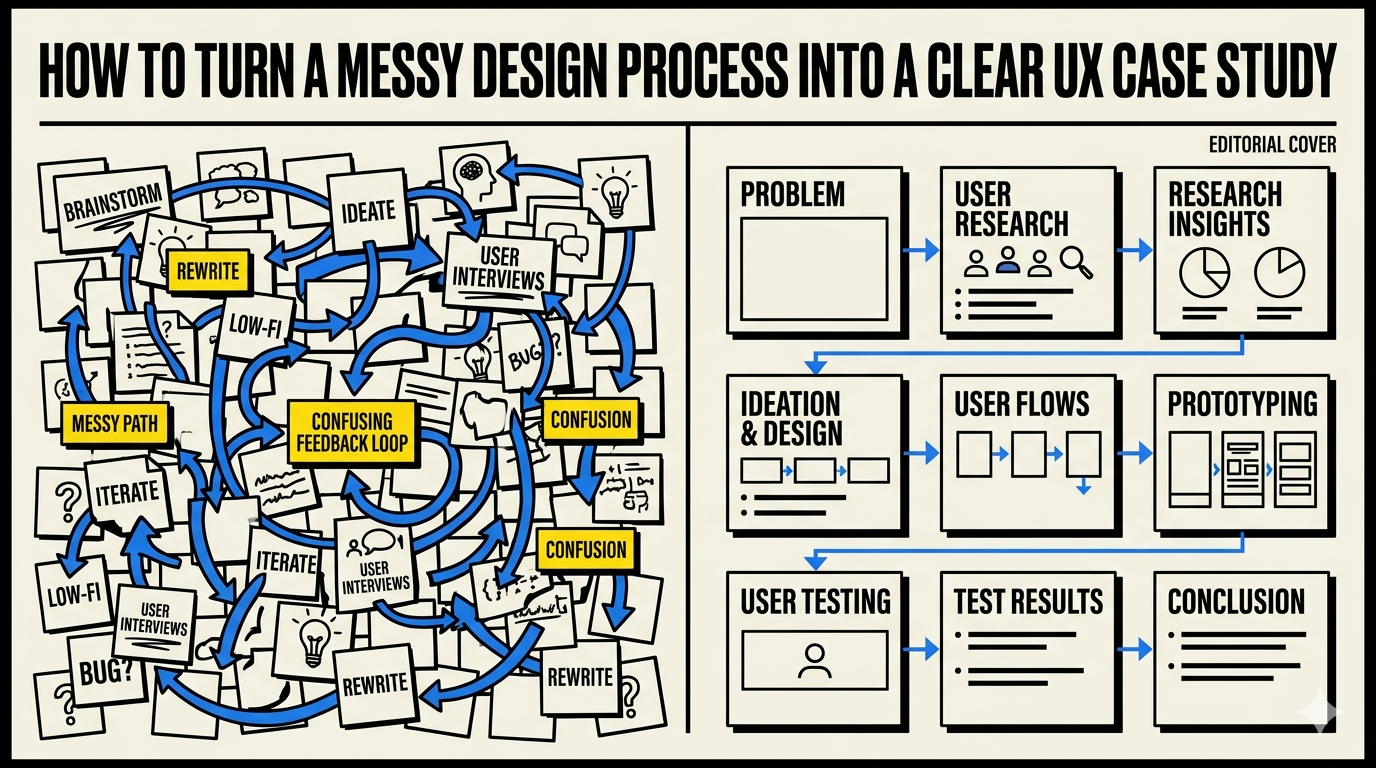
Real design projects are rarely clean.
The brief changes.
Stakeholders disagree.
Research comes late.
The first solution fails.
The team pivots.
But your case study still needs to be readable.
The mistake: pretending the process was perfect
Many designers write case studies as if everything happened in a clean sequence:
Research → Ideation → Wireframes → Testing → Final UI
That may look organized, but it often feels fake.
Real projects are more complicated. Hiring teams know this.
The goal is not to make the process look perfect. The goal is to make your thinking understandable.
A better goal: honest structure
A strong case study does not hide the mess.
It organizes it.
The reader should understand:
- What was uncertain?
- What changed?
- Which decisions mattered?
- What did you learn?
- How did the project move forward?
Honesty is not the opposite of clarity. It is often what makes a case study feel real.
Start with the turning points
Instead of listing every step, identify the moments that changed the project.
These could be:
- A surprising research insight
- A technical constraint
- A stakeholder disagreement
- A failed usability test
- A scope change
- A business priority shift
- A decision to simplify the solution
These are the moments where your thinking becomes visible.
Build the story around decisions
A clear case study is not a diary.
It is a decision trail.
For each important moment, explain:
- What was the situation?
- What options did you consider?
- What decision did you make?
- Why did that decision make sense?
- What changed after that?
This is more useful than showing every workshop, every wireframe, and every meeting note.
Use a simple structure
Try this structure:
- Context
- Problem
- Constraints
- Key decisions
- Solution
- Outcome
- Learnings
This does not mean your process was linear.
It means your story is readable.
What to remove
Remove details that do not help the reader understand the project.
You probably do not need:
- Every research screenshot
- Every early wireframe
- Every stakeholder comment
- Every workshop photo
- Every UI variation
Keep the moments that explain the reasoning.
Final thought
Your process does not need to look perfect.
It needs to be understandable.
A messy project can become a strong case study when the thinking is clear.
Related guides
- You may also want to explain the decisions that shaped the work: read the guide
- You may also want to show your contribution in a team project: read the guide
Related reading
Mar 26, 2026
3 min read
How to Start a UX Case Study When You Feel Stuck
A practical way to begin your UX case study when the blank page feels too big and you do not know what to write first.
Jan 15, 2026
3 min read
How to Explain Your Design Decisions in a UX Case Study
Learn how to turn design decisions into a clearer UX case study narrative that shows how you think, not just what you designed.
Apr 30, 2026
2 min read
How to Read UX Case Study Examples Without Copying Them
Learn what to notice in strong UX case study examples so you can improve your own portfolio without imitating someone else's story.